Reading time: About 5 minutes
Looking for some recommended books in time for Christmas reading? Here’s my semi-annual roundup of books I’ve read this year.
I aim to read 52 books every 12 months, and my habit is to post a complete list of the names of them for you, twice a year. Here is a description of the 31 books I’ve enjoyed in the second half of this year, bringing my annual total to 55. Yes, I really do try to read more than a book a week! (If you want to learn how to read more, see my blog post on the topic or watch my video.)
I give you this list early in December to help you with plans for Christmas reading or giving. I list my top five fiction reads followed by my top five non-fiction ones. After these highlighted titles, I name the other books I’ve read in each category, in order of preference.
Please note I don’t generally read sci-fi or fantasy. I pass no judgment on those who do; my tastes don’t usually run in those directions.
TOP 5 FICTION TITLES:
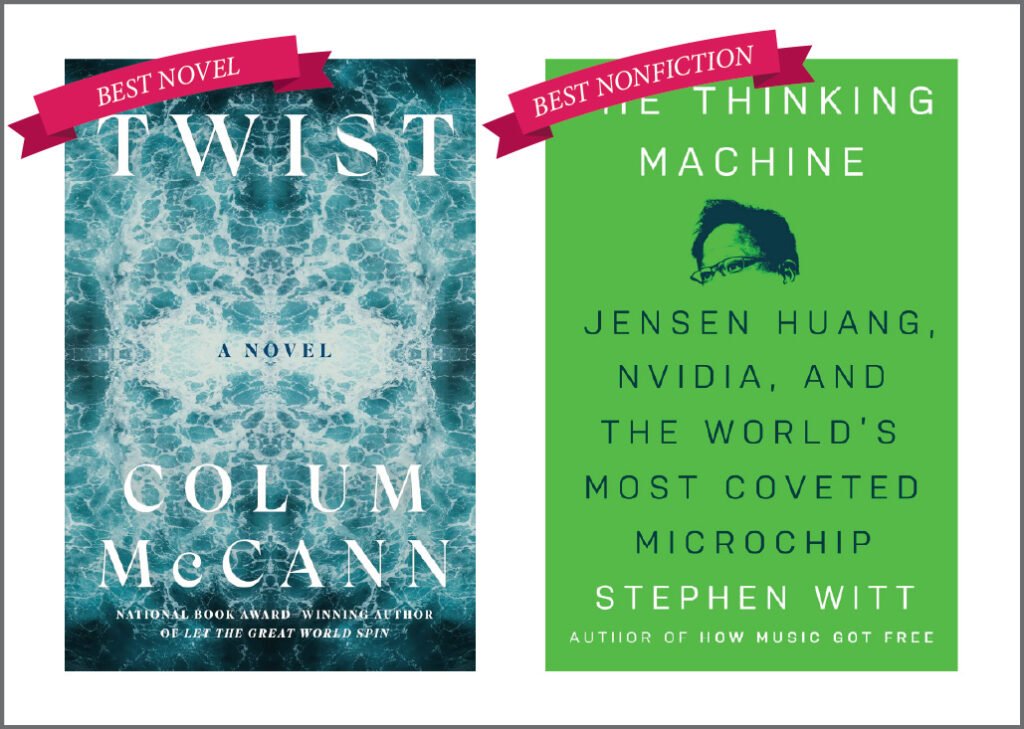
- McCann, Colum. Twist. One of the best books I’ve read in 2025. The story of a journalist who reports on the repair of underwater internet cables. Sounds dry, but it’s not. Memorable characters and sentences built like crystals. I borrowed it from the library, but now I want to buy a copy.
- Wood, Charlotte. Stone Yard Devotional. This book won’t appeal to everyone as very little happens. It’s focused on the interior lives of the characters. And the writing is sublime.
- Chacour, Éric. What I Know About You. A remarkable story about family secrets and the lives of French-speaking inhabitants of Egypt. Exquisitely written, and the author pulls off the unusual task of writing most of the book in the second-person voice, “you.”
- Daré, Abi. The Girl with the Louding Voice. The heartbreaking (but ultimately redemptive) story of a young girl growing up in rural Nigeria and her efforts to educate herself. It’s deliberately written in broken English, in a way that’s both respectful and effective.
- Davies, Carys. Clear. An outstanding piece of historical fiction about the Highland Clearances, focusing on an impoverished minister and the lone occupant of an isolated Scottish island.
Do you have any fiction titles you can recommend? Please name them in the comments section, below.
TOP 5 NON-FICTION TITLES:
- Witt, Stephen. The Thinking Machine. A fascinating biography of Jensen Huang, the man who launched and has been the long-term CEO of Nvidia, one of the hottest tech stocks on Wall Street. A great introduction to AI, too.
- Li, Fei-Fei. The Worlds I See. A memoir of a female Chinese-American immigrant and a leader in the field of AI. Really interesting and written in a friendly and accessible way.
- Brooks, Arthur C. From Strength to Strength. This book’s subtitle says it all: “Finding Success, Happiness, and Deep Purpose in the Second Half of Life.” There are some sobering messages in here for anyone older than 40.
- McNally, Keith. I Regret Almost Everything. A charming and highly likeable memoir from an English working-class lad who became a successful and celebrated New York restaurateur (Balthazar, Pastis).
- Delano, Laura. Unshrunk: A Story of Psychiatric Treatment Resistance. The author was heavily medicated for mental health reasons from her mid-teens. Her book tells the story of how she finally got herself off medication.
Do you have any non-fiction titles you can recommend? Please name them in the comments section, below.
OTHER FICTION (in order of preference)
- Caldwell, Lucy. These Days. Beautifully written novel exploring the life of a family during the Belfast Blitz of the Second World War. Contrasts favourably against another Second World War book I read this year (The Lost English Girl — see item #15, below).
- Kitamura, Katie. Audition. Splendidly written story about an aging actress who meets a young man who believes she’s his mother. Interestingly, the book is divided into two parts, mirroring the structure of a theatrical play and blurring the lines between reality and performance.
- Herron, Mick. The Secret Hours. An often-funny spy thriller about the British Secret Service, this novel was written by the author of the book behind the hit Apple TV streaming show, Slow Horses.
- St. John Mandel, Emily. Station Eleven. I’m never sure whether to use the term sci-fi, speculative fiction or dystopian fiction, but this book falls into one of those categories — not a genre I typically read. Still, I’m a big fan of St. John Mandel, although I didn’t like this book (about the collapse of civilization) as much as I did her later work, The Glass Hotel.
- Choi, Susan. Flashlight. This story, about a Korean family living in Japan and, later, the U.S., is pretty good, although I found it slightly disappointing. To my mind, the writing didn’t live up to the style and sophistication of Choi’s earlier book, Trust Exercise.
- Kwan, Kevin. Crazy Rich Asians. I bought this book in January 2018, before the movie was released. And I only just managed to read it now. Amusing enough but a rather trifling thing, this is the story of three super-rich Asian families.
- Roberts, Adam. Food Person. Lightweight but fun story about a woman who wants to become a food writer.
- Senna, Danzy. Colored Television. A struggling Black writer of literary fiction decides to turn her eye to Hollywood. Although Colored Television was named a “best book of the year” by many leading newspapers and magazines, I found it only so-so, albeit entertaining enough.
- Haslett, Adam. Mothers and Sons. This novel about an asylum lawyer in New York and the backstory of his complex family history didn’t have quite enough to move me. I wish the writing had been more lyrical. Instead, it felt a bit strained.
- Brown, Karma. Recipe for a Perfect Wife. The plot, about an aspiring author, drew me in. But I found the writing to be uneven. And the author’s first name made me a little suspicious about her seriousness (unfair, I know!).
- Ebbott, Hal. Among Friends. The story of two intertwined families and a betrayal. Terrific plot, but the writing was too much for me. Overly self-conscious — trying too hard for a prize.
- Hunter, Megan. Days of Light. The story of a young woman who, just before the beginning of the Second World War, faces a family tragedy. There’s some fine figurative language (the author is a poet), but I found the book to be terribly over-written.
- Kenitz, Daniel. The Perfect Home. So-so domestic thriller set in the world of home renovation TV. The writing is solid, but the characters have too much cardboard in them.
- Nicholls, David. Us. Two very different English people get married, have a child, stay married for 25 years and then separate. The book gets rave reviews, but I left disappointed. Was too dull for me.
- Kelly, Julia. The Lost English Girl. Mildly interesting plot (about a family living through the London Blitz); it is thoroughly spoiled by mediocre writing.
OTHER NON-FICTION (in order of preference)
- Martin, Wednesday. Primates of Park Avenue. The title is the best thing about this memoir. I found it interesting to read about the tortured lives led by people who live in one of the wealthiest ZIP codes in the U.S. But I found the comparisons of wealthy New Yorkers to anthropological research to be a bit forced.
- Shroder, Tom. The Most Famous Writer Who Ever Lived. A competently written family memoir by a well-respected journalist, this was the kind of book that might have been better reserved for family members.
- Radziwill, Carole. What Remains. A memoir by the wife of the late Anthony Radziwill, cousin to John F. Kennedy Jr. Radziwill died tragically young (at 40), of a metastasizing cancer. His wife, who eventually achieved fame in The Real Housewives of New York City, writes about as well as you might expect….
- Loomans, Paul. I’ve Got Time. When Oliver Burkeman (author of the marvellous Four Thousand Weeks) made a positive comment about this book, that was enough for me. Too bad it was disappointing. The idea of using “intuition” to plan my day just didn’t work for me.
- Elmhirst, Sophie. A Marriage at Sea. Although this was a gripping real-life story — about a couple lost at sea after their sailboat was destroyed by a whale — I found the writing too predictable. The author didn’t know how to make the most of the admittedly sensational tale.
- Henderson, Eleanor. Everything I Have Is Yours. I found this memoir to be really difficult to read. The story of a marriage between a successful writer and her husband who has dependency problems and an unknown medical condition, it is unrelievedly bleak and often confusing. I forced myself to finish it, in the hope of some redemption. Spoiler: none arrives.
If you liked this post, be sure to check out the page containing lists of the books I’ve read over the last 10 years.
*
My video podcast last week described the difference between printing and publishing. You can watch the video or read the transcript, and you can also subscribe to my YouTube channel.
*
What are the best books you’ve read this year? We can all learn from each other, so please, share your thoughts with my readers and me in the comments section, below. And congratulations to Hasib Rasoli, the winner of this month’s book prize, for a comment on my Nov. 4/25 blog post about how to get better at noticing. (Please send me your email address, Hasib.) If you comment on today’s post (or any others) by Dec. 31/25, I’ll put you in a draw for a digital copy of my first book, 8 1/2 Steps to Writing Faster, Better. To enter, please scroll down to the comments, directly underneath the “related posts” links, below. You don’t have to join Disqus to post! Read my tutorial to learn how to post as a guest. (It’s easy!)