Reading time: About 4 minutes
Looking for some recommended books in time for summer reading? Here’s my semi-annual roundup of books I’ve read this year.
I aim to read 52 books every 12 months, and my habit is to post a complete list for you twice a year. Here is a description of the 24 books I’ve enjoyed so far this year. Yes, I really do try to read a book a week! (If you want to learn how to read more, see my blog post on the topic or watch my video.)
I give you this list close to the North American summer solstice to help you with plans for your own summer reading. I list my top five fiction reads followed by my top five non-fiction ones. After these highlighted titles, I name the other books I’ve read in each category, in order of preference.
Please note I don’t generally read sci-fi or fantasy. I pass no judgment on those who do; my tastes don’t usually run in those directions.
TOP 5 FICTION TITLES
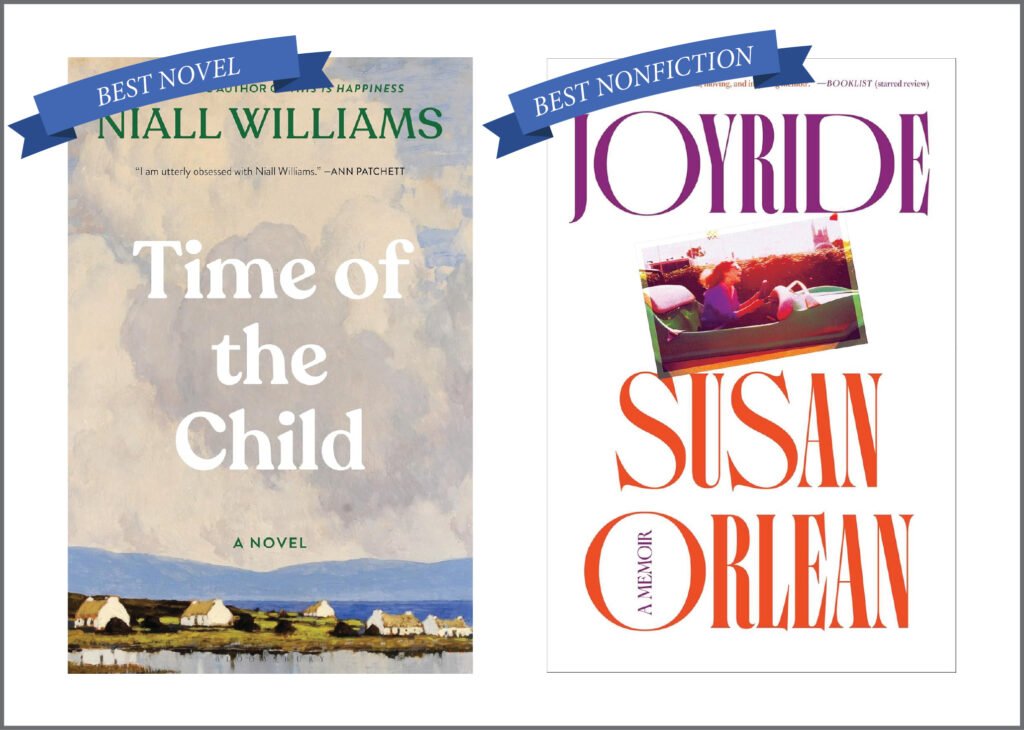
- Williams, Niall. Time of the Child. The Christmas season of 1962 comes to Faha, County Clare, Ireland with a new baby and all the disruption that brings. This is another delightful and compelling story by the incomparable novelist Niall Williams. I normally read quickly, but I read this one S-L-O-W-L-Y so I could fully enjoy the language.
- Boyne, John. The Heart’s Invisible Furies. Powerfully written novel telling the story of an adopted Irish boy — and, through him, the story of Ireland from the 1940s until today.
- Evans, Virginia. The Correspondent. Beautifully written book telling the story of an older woman coming to terms with her life. Here’s what surprised me most: It was an epistolary novel (not a genre I usually like), and I loved it.
- Sullivan, Tim. The Dentist. I don’t read many mysteries, but this is a charming one featuring a detective on the autism spectrum.
- Finn, Patricia. The Golden Boy. A sweetly written and often very funny book about a wealthy couple who are forced to re-evaluate their lives.
Do you have any fiction titles you can recommend? Please name them in the comments section, below.
TOP 5 NON-FICTION TITLES
- Orlean, Susan. Joyride. This is one of the most charming memoirs I’ve ever read, drafted by the masterful author of The Orchid Thief and The Library Book. If you’re a writer, Susan Orlean has a lot to teach you.
- Bringley, Patrick. All the Beauty in the World. What happens when a thoughtful man with decided literary leanings decides to take time off from writing to become a guard at the Metropolitan Museum of Art? A book ensues. And this is a truly magical one — an exploration of art, writing and grief.
- Keefe, Patrick Radden. London Falling. I need little persuading to read anything written by Patrick Radden Keefe; I believe him to be one of the best non-fiction writers alive in the world today. This book, which investigates the death of a privileged 19-year-old London male, doesn’t disappoint, even though it’s not quite as perfect as Keefe’s breakout bestseller, Say Nothing.
- Honey, Chris. The Tenth Nerve. Well-written book by a highly skilled neurosurgeon who has made several ground-breaking discoveries. Would interest anyone who loves medical stories.
- Junod, Tom. In the Days of My Youth I Was Told What It Means to Be a Man. The quirky title of this book (a line from the Led Zepplin song, “Good Times Bad Times”) presages its unusual approach. This one-of-a-kind memoir tells the story of the author’s charismatic and philandering father. That the author is an award-winning journalist makes it all the more interesting.
Do you have any non-fiction titles you can recommend? Please name them in the comments section, below.
OTHER FICTION (in order of preference)
- Ridzén, Lisa. When the Cranes Fly South. A moving although somewhat uneven book tracing the final days of an elderly Swedish man, his dog and his troubled relationship with his son. Part of the middle is dull and plodding, but the ending is amazing.
- Stevens, Nell. Briefly, A Delicious Life. This novel has an incomparable cast of characters: George Sand, Frédéric Chopin and…a ghost. Charmingly told, but not as delightful as the author’s earlier memoir, Bleaker House.
- Sullivan, Tim. The Patient. Another in a mystery series featuring the fictional Detective Sergeant George Cross, who is on the autism spectrum. Enjoyable but not quite as charming as the first in the series, The Dentist. (See above.)
- McEwan, Ian. What We Can Know. I’m normally a big fan of McEwan’s work, but I found this novel to be disappointing and boring. It stuttered to life in the final 20 percent, when it focused on one of the more interesting characters.
- Markovits, Ben. The Rest of Our Lives. I found it hard to warm to this book in which not much happens, apart from a minor road trip by the principal character who doesn’t have a terribly interesting life. That said, it’s very readable and was even a finalist for the Booker Prize, but I found it too mundane.
- Levi, Allen. Theo of Golden. I read this book because it was a surprise bestseller by a first-time novelist. A sweet story about a man who lands in a (fictional) small town, it’s a bit preachy and dramatically safe. Easy to read, though.
- Yeatman, Robin. Bookworm. I picked up this book on a remainder shelf. Described as a “black comedy,” focusing on a woman in an exceptionally unhappy marriage, the book comes across as fairly mediocre chick lit. I found some redeeming notes in the last 25 percent though.
- Ojito, Mirta. Deeper Than the Ocean. A multigenerational story of Spanish/Cuban immigrants, the novel was written by a journalist and Pulitzer Prize winner. But it’s a debut novel and has many weaknesses.
- Miller, Kirsten. Lula Dean’s Little Library of Banned Books. This satirical novel about book banning is clever but not as clever as it aspires to be.
OTHER NON-FICTION (in order of preference)
- Bassist, Elissa. Hysterical. This book describes and shakes its fist at the many ways in which women are underserved by the medical system. It’s also funny in places.
- Ho, Wiley Wei-Chiun. The Astronaut Children of Dunbar Street. I was especially delighted to read this book written by a client of mine who grew up in my own neighbourhood. (My home is half a block away from Dunbar Street.) Wiley was a self-raising kid, brought to Canada by her Taiwanese parents and left here alone with her siblings when her parents needed to return to their native country.
- Young, James Webb. A Technique for Producing Ideas. I’d seen many references to this book over the years (it was written in 1940), and when I saw a Kindle version available for just 99 cents, I decided to buy it. Webb’s system for bolstering creativity is simple: (1) gather raw material (2) think about the material (3) let the idea “go underground” (4) wait for the idea to come (5) refine and develop the idea. It’s a super short book and took me less than an hour to read.
- Burden, Belle. Strangers. Interesting book — the story of a very wealthy 50-something woman who is left by her husband, with no explanation, even while their children are still living at home. While it’s cleanly written, I fear she wrote the book too soon after her divorce. There’s little sophisticated analysis here.
- Brown, Alton. Food for Thought. This is a book of essays for foodies (and probably not for anyone else). Nevertheless, I enjoyed it. Perhaps because I have such fond memories of watching Alton Brown on TV with my food-obsessed children.
Something I’m loving right now…
The post you’ve just read also arrives in inboxes every Tuesday — and subscribers get something extra. Each week, I include a brief, subscriber-only bonus: a short paragraph featuring a practical tip about a tool, book, video, app or resource I’ve tested and loved. This bonus is never published on my website — only in the email. No fluff. No sales pitch. Just one smart recommendation to make your writing life easier. Subscribe to my newsletter to get next Tuesday’s love note.
*
My video podcast last week described how copyright protects you. You can watch the video or read the transcript, and you can also subscribe to my YouTube channel.
*
Have a friend who stops to fix every sentence when they write? Forward this newsletter along to them. If they sign up, I’ll send them my free video on how to stop editing while you write — my gift to get the words flowing.
*
What’s one of the best books you’ve read so far this year? We can all learn from each other, so please, share your thoughts with my readers and me in the comments section, below. If you comment on today’s post (or any others) by midnight tonight (June 30/26), I’ll put you in a draw for a digital copy of my first book, 8 1/2 Steps to Writing Faster, Better. To enter, please scroll down to the comments, directly underneath the related posts links, below. You don’t have to join Disqus to post! Read my tutorial to learn how to post as a guest. (It’s easy!)