Reading time: About 2 minutes
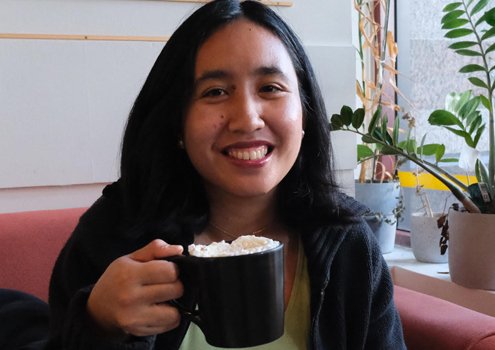
Writer Phebe Ferrer believes that writing poetry is a skill that can be taught and learned. And that anyone can write poetry…
The poetry of Phebe Ferrer appears in Qwerty Magazine, Marias at Sampaguitas, and Chinatown Stories, among others. She has edited creative anthologies featuring work by QTBIPOC artists with decomp journal and Chinatown Stories and organized workshop series including Pamana: Exploring Family Histories and from our roots to yours. Together with Steffi Tad-y, Phebe co-leads the Poesiya Collective, where they host poetry workshops and book clubs on themes of migration, family histories, and care.
Q. Roughly how much time do you spend writing every day?
I am still working up to having a regular writing time every day. What has really helped me are writing/creative hangouts with my friends, where we gather specifically to write and make art. I also try to keep a small notebook handy, for whenever words come. I especially like to write and read on the bus, where I can see people come and go about their day.
Q. What’s a simple activity or habit that makes you a better writer?
Reading! I think that reading different books, genres, authors and kinds of poems enriches my writing mind and is a big source of inspiration.
Q. What interferes with your writing?
I get in my own way a lot! Changing my habits away from being on social media to focusing on reading and writing is difficult (and recently, social media has been proven to be addictive). Writing in a notebook at the library, a cafe, or outdoors sitting on a bench helps a lot with this.
Q. How do you persuade yourself to sit down to write on days when you really, really DON’T feel like doing it?
Setting a specific goal for myself helps: telling myself that I only have to write a couple of words, or one poem, even if it isn’t good. Other times, I try a method I often use in my poetry workshops, where I read for a few minutes and then write. I think writing poetry in a disciplined way can be difficult, because there is an aspect of it that is like waiting for the muse to visit and grant you words. That said, putting down even a couple of words can lead to a writing flow.
Q. Is there a particular motto or saying that you’ve found helpful for writing?
One of my good friends often tells me, we must live in order to write. The living is a necessary part of writing. This reminds me to take care of myself and watch the world around me, which then makes its way into my writing.
Q. Which stage of the writing process do you enjoy the most: researching, writing or editing/rewriting and why?
I really enjoy the writing. There is a magical moment when the words flow out and already seem to be beautiful together as a poem. I love these moments and am grateful for when they happen. Of course, not every poem will be this way, and even first drafts that already seem to be perfect can still be workshopped.
Q. What’s one of the best books you’ve read (either fiction or non) in the last five years?
Babel by R.F. Kuang — this book has such insightful things to say about imperialism and its impact on languages, cultures, and people. It is also about friendship, love, and academia — and it is absolutely devastating at the end.
I also love The Galleons by Rick Barot, a beautiful book of poetry about family histories and the long aftermath of colonialism. I am in awe of his ability to say something seemingly simple, but that keeps you thinking about the layers of meaning behind his words.
Q. What book are you reading right now?
Katabasis by R.F. Kuang — I’m currently obsessed with her distinct voice and ability to pull you into her words.
Q. What do you think is the biggest misperception that new writers have about the act of writing?
With poetry, I think people assume that they must already be poetic to write poetry. I would gently push back — while there is talent involved in writing poetry, I think it is also a skill that can be taught and learned. When I learned how poets meticulously work on and workshop their writing, I saw how poems are very intentional pieces of work, and how this requires practice. Anyone can write poetry!