Reading time: About 2 minutes
Pamela Taylor says that being a successful author involves a lot more than just writing a book…
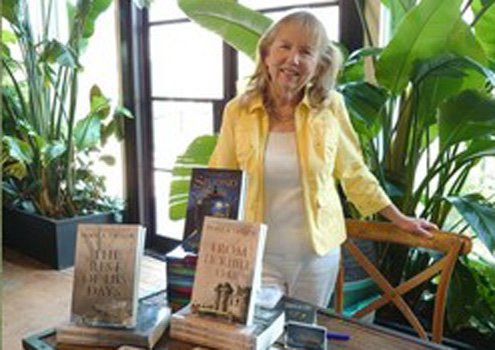
A self-professed history geek, Pamela’s trip-of-a-lifetime may have been the one that allowed her to touch a 700-year-old book. Her novels include the nine-volume series Second Son Chronicles, The Rest of His Days (a novel of the fate of Edward II of England), From Tickhill, 1348 (Joanna of Flanders in the Hundred Years War), and The Last Priest of Tintagel.
A prequel to the Chronicles (The Abbot, The Knight, and The King) will be released in April 2026. Pamela’s work consistently appears in Amazon’s Top 100 for Medieval and Renaissance Historical Fiction.
I was excited to talk to Pamela about how she approaches writing.
Q. Roughly how much time do you spend writing every day?
It varies widely. If my characters have a lot to say on any given day, I’ve been known to write late into the evening.
Q. What’s a simple activity or habit that makes you a better writer?
I could go with the clichéd anwers – “writing” or “reading” – and those have become cliché only because they’re true. But I’ve learned an enormous amount as a freelance editor. Seeing and assessing what works (or doesn’t) for other writers has given me good insights into my own writing.
Q. What interferes with your writing?
Laundry. Although sometimes it’s the other way around – the writing interferes with getting the laundry done. Humor aside, I feel most at loose ends when I don’t have the next book idea already background processing in my head while I’m finishing my current work in progress.
Q. How do you persuade yourself to sit down to write on days when you really, really DON’T feel like doing it?
I don’t. If I force myself, the writing comes out forced. So I spend those days on things like preparing my newsletter, designing graphics for my social media or tchotchkes for book fairs, looking for book festivals or other opportunities for engaging new readers, arranging signing opportunities – or getting the laundry done. And my dogs never complain if I have more time for them.
Q. Is there a particular motto or saying that you’ve found helpful for writing?
Not really.
Q. Which stage of the writing process do you enjoy the most: researching, writing or editing/rewriting and why?
My favorite research is what I call “research by osmosis” – visiting sites that will figure in a story and soaking up the flavor and history of the place and taking lots and lots of pictures. The internet has also made it possible to do just-in-time research, so I can fill in the gaps when the story requires. And unlike many authors who do a complete, rough first draft and then revise/refine, I prefer to edit and rewrite as I go. So for me, all the phases are rather intermingled, and I enjoy it all.
Q. What’s one of the best books you’ve read (either fiction or non) in the last five years?
Really hard to pick just one, since I have a broad range of reading interests. But I can recommend all the following without hesitation: Bernard Cornwell’s Fools and Mortals; Ken Follett’s Never; Kate Quinn’s The Rose Code.
Q. What book are you reading right now?
I recently finished Alison Weir’s The Cardinal and just bought Maggie O’Farrell’s Hamnet but haven’t started it yet. I have a little more pawing around in some heavy (both literally and figuratively) non-fiction tomes related to my work-in-progress to finish before I can return to reading for pleasure.
Q. What do you think is the biggest misperception that new writers have about the act of writing?
That all they need to do, to be a successful published author, is write the book. Writing the book is just Step 1. Yes, there will be rejections, but there are more routes to publication available today than ever before. Regardless of your path, though, you will still have to invest time and energy in promoting your work and growing your reading audience. So the sooner a new writer embraces the notion that being an author is a business, the sooner success will follow.