Reading time: About 2 minutes
James Young likes to use a musical analogy for the act of writing: “There doesn’t have to be a “drum fill” after every verse or refrain; sometimes, you are just keeping the rhythm….”
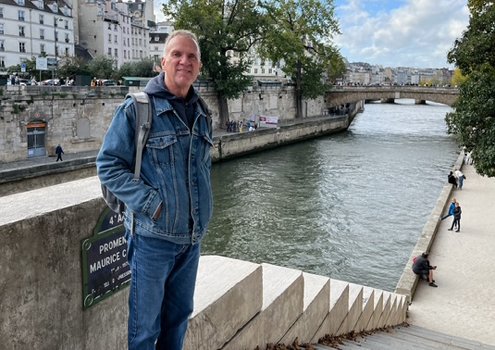
James Young spent 14 years as a staffer in the Senate and House, four years at the Office of Management and Budget and the Dept. of Treasury, and almost two decades as a Fortune 20 Company’s Director of Governmental Relations. His first book is Time-Stopper: Interludes in Time. Born in Alabama, James received his B.A. from the University of Chicago and his PhD from Cornell University. In his early days, James was Kipling’s “cat who walked by himself,” working in a steel mill, sailing on the Great Lakes’ iron ore boats, tending bar, riding motorcycles, scuba diving, traveling extensively worldwide. Now, his traveling is more sedate and done with his family.
I was excited to talk to James about how he approaches writing.
Q. Roughly how much time do you spend writing every day?
Six to eight hours on various projects.
Q. What’s a simple activity or habit that makes you a better writer?
Walking and exercising are both daily activities where I can get lost in my thoughts and work through scenes in my head.
Q. What interferes with your writing?
Well, we have a very persistent cat who regularly jumps onto a table and puts his paws on my lap. More seriously, just the mundane of ordinary life—”the world is too much with us” and all that, the urgent surmounting the important.
Q. How do you persuade yourself to sit down to write on days when you really, really DON’T feel like doing it?
I tell myself to either sketch (jotting down thoughts without an organization and which I can assemble later) or “just drive the narrative.” On the latter, this means just telling the story through the scene you are working on; it is a direction violation of the dictum “show, don’t tell;” however, it serves a purpose to allow the story to go forward when I may not necessarily “see the scene” in my head. You can come back and fill it out later. To use a musical analogy: There doesn’t have to be a “drum fill” after every verse or refrain; sometimes, you are just keeping the rhythm.
Q. Is there a particular motto or saying that you’ve found helpful for writing?
My mother was a great admirer of literature, and she loved a phrase by Epictetus, which my father made into a bookmark for her. I keep that bookmark on a nightstand; it reads in part: “You have been given your own work to do. Get to it right now, do your best at it, and don’t be concerned with who is watching you.”
Q. Which stage of the writing process do you enjoy the most: researching, writing or editing/rewriting and why?
I enjoy going back through the first draft of a manuscript. This is where you add in all the touches — how people are holding themselves, their environment, etc. — that were left out of the “driving the narrative” process. You are working with a full idea and story and can therefore dedicate your full attention to telling it.
Q. What’s one of the best books you’ve read (either fiction or non) in the last five years?
John M. Barry’s The Great Influenza and Edmund Morris’s Beethoven: The Universal Composer.
Q. What book are you reading right now?
James Romm’s Plato and the Tyrant, Paul Kengor’s American Pontiff, and the Book of Proverbs.
Q. What do you think is the biggest misperception that new writers have about the act of writing?
That it comes easily or painlessly. Both the writing and the book production are hard, and the latter especially can be painful.