Reading time: About 2 minutes
An unrepentant “binge writer,” Ruth F. Stevens sometimes has to force herself to take breaks when she’s deeply embroiled in a writing project…
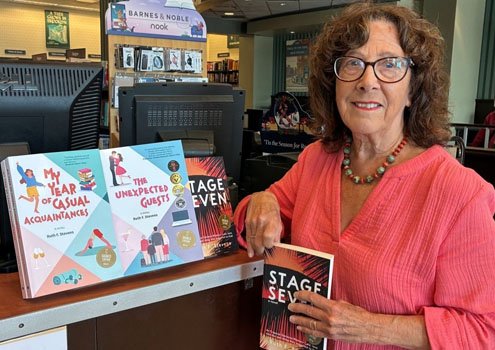
Ruth F. Stevens is author of the award-winning South Bay Series, My Year of Casual Acquaintances and The Unexpected Guests. She is also the author of Stage Seven, a funny-sad contemporary novel about caregiving and Alzheimer’s Disease. As well, she has written two theatrical plays. Before that, Ruth was a public relations and advertising executive in New York and Los Angeles, where she’s lived since 1983. She enjoys travel, hiking, wine tasting, hip hop, Broadway musicals, and visiting her grandsons in Manhattan.
I was excited to talk to Ruth about how she approaches writing.
Q. Roughly how much time do you spend writing every day?
When I’m immersed in a project, I write from four to eight hours a day as time allows. When I’m not working on a book, I write zero minutes a day. A colleague describes this as “binge writing”.
Q. What’s a simple activity or habit that makes you a better writer?
Walking! I’m not sure why a long walk stimulates creativity, but it often helps me come up with good story ideas. I’ve even mapped out full chapters in my head while walking. I’ll record messages on my phone to make sure I don’t forget anything important.
Q. What interferes with your writing?
Book marketing. Though promoting one’s work is essential for every writer, it can be a time-suck and a distraction. I’ve lamented this problem with many published authors, and everyone agrees it was so much easier when all we had to worry about was the writing itself.
Q. How do you persuade yourself to sit down to write on days when you really, really DON’T feel like doing it?
When I’m “binge writing,” this doesn’t happen. In fact, I have to make myself take breaks to do other things. When I’m between projects, I don’t force myself to write, but I find it helpful to think about what’s coming next and jot down notes and ideas.
Q. Is there a particular motto or saying that you’ve found helpful for writing?
“Writing is rewriting.” I don’t know who first said this, but apparently many famous writers — from Ernest Hemingway to Roald Dahl – have expressed this sentiment in different ways. I didn’t understand the wisdom of these words until I had to dive into the second draft of my debut novel.
Q. Which stage of the writing process do you enjoy the most: researching, writing or editing/rewriting and why?
Writing! Especially when a character comes to life and says or does something I didn’t expect. But I also enjoy editing/rewriting. After the story is written, it’s challenging but satisfying to polish it and work out the kinks.
Q. What’s one of the best books you’ve read (either fiction or non) in the last five years?
I love Elizabeth Strout, and Tell Me Everything is one of her best. The way she brought all her favorite characters together was brilliant. The Correspondent by Virginia Evans is another recent favorite. It’s a fresh and original take on the elderly curmudgeon character.
Q. What book are you reading right now?
I’m reading the new Ann Patchett novel, Whistler, and listening to the audiobook of Lisa Groen’s The Cassatt Sisters, a fascinating historical fiction title about Impressionist painter Mary Cassatt and life in Paris in the Belle Epoque. I recommend both!
Q. What do you think is the biggest misperception that new writers have about the act of writing?
When I was a new writer, I regarded writing as strictly a solo occupation. Over time, I learned that writing is more productive (and fun) when sharing one’s work with critique partners or groups, trusted early and beta readers, etc.