
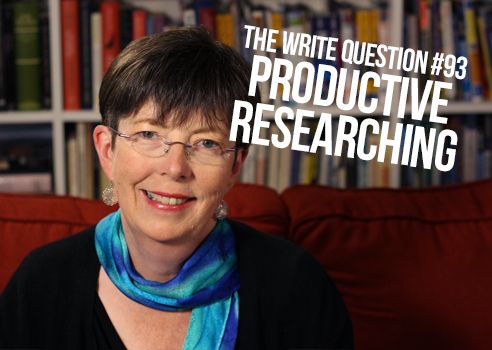
Viewing time: 4 mins. 36 secs.
The Write Question is a weekly video podcast about writing that I started in 2017 and that ran, more or less weekly, until April 2022. This is a republication of issue #92, which describes how to make your research more effective. The post first ran on Sept. 10/21.
Transcript:
Welcome to The Write Question. I’m Daphne Gray-Grant and my topic today is how to make your research more productive.
I have an email from Abhijit Chakraborty, a PhD student in economics based in Siliguri, a city in West Bengal, India. Here’s what he’s asked:
“I have been struggling to learn how to write properly for years, but I have failed . I read a lot of reference material, but with writing, I usually end up jumbling my thoughts and mostly can’t remember much of what I’ve read. Should I take notes continuously as I am reading? And how do I relate to things I’ve read earlier as I’m writing new text?
Thanks for your question, Abhijit. I’m going to go out on a limb here and say that your problem is not your writing. Your problem is that you don’t have a well-managed research process.
How do I know this? It’s your question “Should I take notes continuously as I am reading?” Of course, you should! Unless you have the rare gift of a photographic memory. Every academic needs to take notes constantly while reading, and it is not a sign of inadequacy or inferior intellect. It’s a way to organize your thinking and keep better track of it.
Taking detailed notes will be essential for you when you go to create your list of citations. The best thing you can do is invest some time in learning software to help you manage this job.
I’ve always used the program Evernote and found it to be extraordinarily helpful and easy to use. See link below. The basic version is free of charge and this web-based software is used by millions of people around the world.
But because Evernote wasn’t designed for academics in particular, it can not create citations for you. Other types of software do.
Here are the names of some you might want to consider:
- Zotero
- Mendeley
- Citavi (PC only)
See links below.
Each of these pieces of software will allow you to save your research — in a fashion similar to Evernote — but they will also create the correct citations for you, in whichever style your program demands: APA, MLA, Chicago or other.
It will be well worth your time to learn about — and use — one of these pieces of software.
I’m just guessing based on your background in economics, but I think Zotero might be the most natural fit for you. Talk to your supervisors and colleagues and see what they think. Also, check with your university’s library and see if it can provide support for any of these programs. Many universities will do this.
Another trick I want to strongly suggest to you is to start keeping a research diary. Every day you research, take a brief bit of time to flip through what you’ve read and write your own reflections on it. This is not just a summary of what the other researchers and academics have said. Instead, it’s your reaction to this information.
You can even file these notes in your citation management software as well. The big benefit of keeping a research diary is it will get you thinking and writing early in the process so you’re less likely to suffer from writer’s block. I’m including a link below to a post I wrote about the benefits of research diaries.
So, to summarize, I have three suggestions for you, Abhijit: Take notes obsessively. Get some citation management software with which to keep those notes. And start a research diary. If you take these three steps, I’m certain your writing will improve.
Finally, let me wrap up with a quote from the African-American novelist Zora Neale Hurston: “Research is formalized curiosity. It is poking and prying with a purpose.”
Abhijit, I know that academics often see the writing process as sitting at a keyboard and producing words. But really, writing is a whole lot more complicated than that. It’s many steps. Managing your research carefully and mindfully is a key part of that process.
Links
Citavi (PC only)
Why you should consider keeping a research diary
An earlier version of this post first appeared on my blog on May 31/19.