Reading time: About 2 minutes
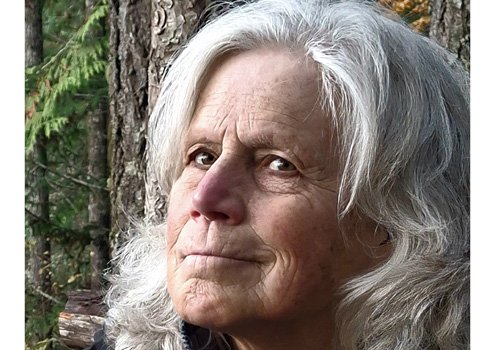
Judy LeBlanc cherishes the Chekov quote: Chekhov quote, “To make a face out of marble means to take away everything but the face,” because she appreciates the sculpting metaphor.
Judy LeBlanc’s stories and essays have appeared in magazines, most recently Geist, 2025, and in Don’t Tell: Family Secrets. She’s the author of The Promise of Water, short stories, The Broken Heart of Winter, a novel, and Permission to Land, a memoir. She’s co-edited an anthology with her daughter, Tasha Page, titled Barren. She is grateful to live on the traditional territory of the Qualicum Nation.
I was excited to talk to Judy about her approach to writing.
Q. Roughly how much time do you spend writing every day?
It averages out at about three to four hours a day, though this has varied through the years.
Q. What’s a simple activity or habit that makes you a better writer?
Reading both in the subject/genre I am writing, but also for voice, style etc. It’s sometimes intimidating because the writing feels so beyond anything I could do, but I learn from other writers, and reading opens my mind to possibilities. Also walking. It clears my head and allows my thoughts to wander into whatever project I’m working on.
Q. What interferes with your writing?
Family and household demands, sometimes the internet, though I limit my social media to Facebook.
Q. How do you persuade yourself to sit down to write on days when you really, really DON’T feel like doing it?
Routine. I like the mornings, the earlier, the better. And music can be inspiring. If I choose it carefully, it can somehow fix me to the chair. I have a Spotify account.
Q. Is there a particular motto or saying that you’ve found helpful for writing?
I’ve always liked the Chekhov quote, “To make a face out of marble means to take away everything but the face.” I like the sculpting metaphor. Our material is vast, and it’s the story within it we must find. It’s like a treasure hunt through the first dense and elusive layers.
Q. Which stage of the writing process do you enjoy the most: researching, writing or editing/rewriting and why?
I often find the initial draft is a slog, but once the material is there on the page, I welcome the shaping, deepening, sharpening. That’s my joy.
Q. What’s one of the best books you’ve read (either fiction or non) in the last five years?
So many. I discovered Annie Ernaux a couple of years ago and continue to read through a number of her slim memoirs, but her The Years was most astounding. This took me to another French author, Marguerite Dugas and the autobiographical novel The Lover, a book I wish I’d read years ago. Not to overlook Canadian authors (so many good ones), I finally recently read All My Puny Sorrows, a heartbreaking and honest novel by Miriam Toews.
Q. What book are you reading right now?
Show Don’t Tell by Curtis Sittenfeld, a collection of short stories. I recently discovered her when I heard her read at the Vancouver Writers Fest. Her stories are funny, with well-drawn characters, and offer some insight into our messy and flawed ways. I’m also reading Rambunctious Garden by Emma Maris, which I think is a relatively little-known book I picked up at a Rotary sale. It’s an informative survey of our relationship (that is, Euro/settler centric) with the natural world.
Q. What do you think is the biggest misperception that new writers have about the act of writing?
They think it’s easier than it is to do well. Much about the writing practice is boring and requires nothing more than old-fashioned un-sexy discipline. And revision, lots of it.