
Reading time: About 2 minutes
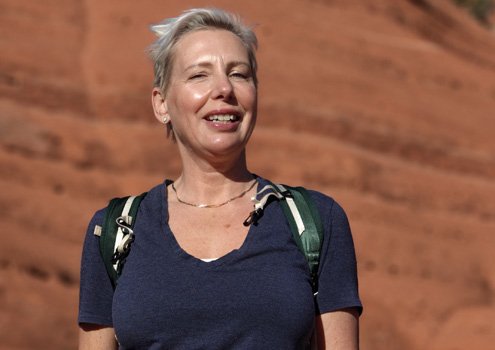
Walking in nature is one of the ways Dhana Musil inspires herself to write. She says it helps prepare her for long periods of sitting and creating…
Dhana Musil lives on the unceded and occupied territories of the Squamish, Musqueam, and Tsleil-Waututh people in British Columbia, Canada. She is a mother of two daughters and is a graduate of The Writers Studio at SFU. Her stories and essays have been published in various anthologies and literary journals such as The Ex-Puritan, The Tahoma Literary Review, Grain Magazine, SugarSugarSalt Magazine and Huffington Post.
I was excited to talk to Dhana about how she approaches writing.
Q. Roughly how much time do you spend writing every day?
In a perfect world, I’d say 5+ hours, but in reality, it varies. I don’t have a predictable or routined life, so I slot it in around kids, travel, exercise, my dog, which isn’t ideal, I know. But I do try to write at least two hours a day.
Q. What’s a simple activity or habit that makes you a better writer?
Walking in nature is non-negotiable. I need the sounds and smells of nature to give me energy. I think the left brain/right brain, left foot forward, right foot forward motion gets me to tap into my creativity which prepares me for long periods of sitting and emoting.
Q. What interferes with your writing?
Honestly, my social life. I feel terrible complaining about this–but I have such a large and rich tapestry of interesting friends; friends who invite me to fun things that are sometimes impossible to say no to.
Q. How do you persuade yourself to sit down to write on days when you really, really DON’T feel like doing it?
Honestly, unless there’s an editor waiting for rewrites or some self-imposed deadline I’ve given myself for a contest or submission call, if I really don’t feel like writing, I’ll do something writing adjacent, like read or type words and phrases from books l want to learn from. Barring that, if I really, really don’t feel like sitting still, I’ll allow myself to go do something else and then return to my writing later.
Q. Is there a particular motto or saying that you’ve found helpful for writing?
“Please help me get out of the way so I can do the work that wants to be done.” by Julia Cameron. Because usually, it’s me getting in my way. I think this applies to a lot of us.
Q. Which stage of the writing process do you enjoy the most: researching, writing or editing/rewriting and why?
Today, my answer is: editing/rewriting. (Tomorrow my answer might be different) I love coming back to half written/partially written pieces — molding and shaping them into something (hopefully) publishable. I feel almost like a detective when I do this, searching my writing for themes, through threads and motifs.
Q. What’s one of the best books you’ve read (either fiction or non) in the last five years?
I don’t like the word “best.” It’s so arbitrary. But I did recently listen to and love, The Heart in Winter, by Kevin Barry. I don’t usually listen to audiobooks because I like to circle text and scribble marginalia, but this is a book I listened to on a long drive. Even now, six months later, I’m still thinking about the two main characters. I’ll have to buy a print copy soon, so I can get my pen out!
Q. What book are you reading right now?
Right now I’m sitting at the airport and I have Naked by David Sedaris in my bag.
Q. What do you think is the biggest misperception that new writers have about the act of writing?
That it’s easy to get published. I don’t know how many times new-ish writers have said to me, “I’m working on my debut novel. I’m writing it in a month.” It’s fantastic that they are enthusiastic, but in truth, (in my truth anyhow,) writing takes time. It’s a craft one learns over a lifetime.