
Reading time: About 2 minutes
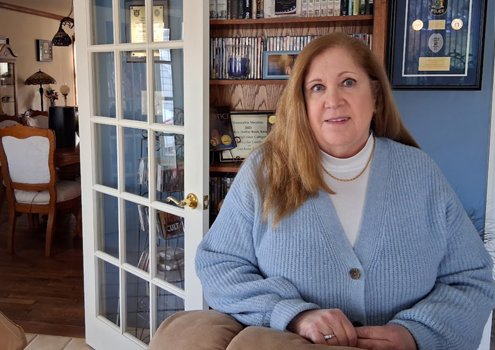
Laura Pulaski says it’s not that difficult to begin writing a book. Just open your computer and type “Chapter 1,” then take it from there….
Laura Pulaski, who writes under the name LeeAnne James, was born and raised in Central New York, but after retirement, moved with her family to Gettysburg, Pennsylvania. She graduated from college with a degree in journalism and initially worked as a typesetter, proofreader and layout artist. Following that, she took a job with her local judicial court and, after that, with her local police department, where she worked for 22 years. That experience was the basis for her books, three of which became an award-winning series based on actual cases investigated by her department: Justice for Loretta, The Dusty Road to Homicide and Five Roses for Walter. Her first book, Murder at Gatewood, was a 2019 Central New York fiction finalist and each book within the Thin Blue Line Series has received awards as well.
I was excited to talk to Laura about how she approaches writing.
Q. Roughly how much time do you spend writing every day?
My current work in progress is historical fiction, which takes a fair amount of time researching. I try to spend at least an hour or two on the book every day, although that might include research, writing, and rewriting what I just wrote the day before.
Q. What’s a simple activity or habit that makes you a better writer?
I enjoy reading first thing in the morning after my husband leaves for work (I’m retired) when the house is nice and quiet. Sometimes I’ll read a word or phrase in a book that could be used in my manuscript. For example, I recently came across the phrase “stretcher bearer” and immediately thought it would fit into a certain paragraph in my manuscript, so I wrote it down on a notepad. Sometimes a simple phrase like that will clarify the description I’d already written in the manuscript that may be too wordy. Later on, I’ll go back to that area in my manuscript and substitute the text.
Q. What interferes with your writing?
I retired at the end of August 2024 and absolutely love retirement. I’m finally working on projects around the house that I hadn’t taken the time to do while I was working, things like organizing our photos and my recipes. I’ve also gone back to my roots as a proofreader, and I’ve been proofreading for other authors. As a result, I don’t always have time to work on my writing, but even if I’m not sitting at the computer, I find myself thinking about how to work the next steps into the plot.
Q. How do you persuade yourself to sit down to write on days when you really, really DON’T feel like doing it?
If I don’t feel like writing, I don’t. I’ve found that if I force myself when the creative juices aren’t flowing, I end up struggling to bring the correct words to the page.
Q. Is there a particular motto or saying that you’ve found helpful for writing?
I’ve always believed that everything can always be tweaked, and that includes my writing.
Q. Which stage of the writing process do you enjoy the most: researching, writing or editing/rewriting and why?
The writing to me is the most enjoyable part. I have an idea of where I want the book to go, but I don’t know about the details until I’m actually writing it. If anyone were to look closely while I was writing, they might find a lightbulb glowing over my head when the ideas come to mind.
Q. What’s one of the best books you’ve read (either fiction or non) in the last five years?
I read for a couple hours every day and have read many wonderful books, so narrowing it down is a struggle. I would have to say Jeffery James Higgins’ Furious: Sailing Into Terror is a favorite and Dawn Merriman’s Messages of Murder Series are favorites. I’ve also read a couple of books by Mary Higgins Clark, one of my favorite authors.
Q. What book are you reading right now?
I just finished Joe Lewis’ Spiral Into Darkness this morning.
Q. What do you think is the biggest misperception that new writers have about the act of writing?
I’ve talked to people before who’ve said, “I’ve always wanted to write a book” but they’re either afraid to begin or don’t think they have the time. It’s not that difficult. Simply open a blank page in Word, a notebook, or a napkin at a restaurant and start with “Chapter One.” Even if it takes several years, so what? Eventually it’ll come together through persistence.