
Reading time: About 3 minutes
Academic writing is challenging. Here are four mistakes that will stall your dissertation….
If you want more support and accountability for your writing, now is the time to think about joining my three-month writing program. The quarterly admission window closes at 11:59 p.m. Thursday, and the next opportunity to join won’t be until August 1. Participants consistently tell me it helps them write every day — and makes both writing and editing far less painful. That’s why the program is called Get It Done!
When I attended university, I was lucky enough to have a desk in my department’s reading room, a space reserved for grad and honours students.
I can remember the scene clearly. Each morning, around 8:30 a.m., most of us would stream in with smiles on our faces and books and coffees in hand. A few moments later, a quiet, depressed-looking woman wearing a grey anorak and blue jeans would trudge into the room and wordlessly take her seat in a back corner.
The rest of us whispered about her. Rumour had it she’d been working on her PhD for more than 10 years and just couldn’t finish her dissertation.
I immediately resolved never to become that person.
Many people think writing a dissertation is about intelligence or expertise. But it’s not. It’s about process, stamina and not letting your mind manage you.
A dissertation is not a magnum opus. The required length will vary depending on your university and your department, usually ranging from 40,000 words to 100,000+ words.
But a dissertation is also not a long essay. Instead, it’s an original contribution to knowledge. You need to shift from being a student who is answering questions to a thinker who is making an argument. Your supervisor is looking for evidence you can think independently, not just regurgitate other people’s ideas with slightly different punctuation.
And the main idea? To finish the damn thing. Done is the goal. Elegance comes later (if at all). One of the biggest misconceptions is that you need to feel ready before you write your dissertation. But in fact, you become ready by thinking and writing. Clarity comes from the process, not before it.
Here are four mistakes that often derail grad students:
Mistake #1: Not getting crystal clear on the research question
The main reason dissertations stall is that they start with a vague or too-broad question. A good research question is specific, arguable and, well, researchable.
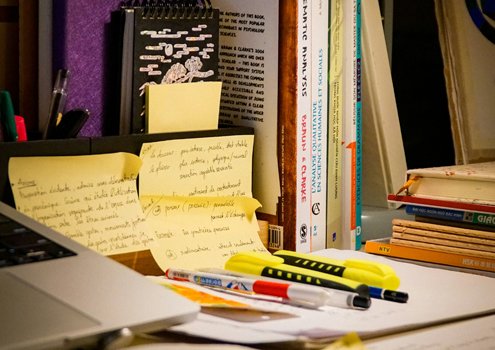
Here’s a tip: write your research question on a sticky note and put it above your desk — every paragraph should serve it. Don’t let scope creep (the academic equivalent of going to IKEA for a lamp and leaving with a sectional sofa and a new rug) kill your momentum.
Also, don’t try to “get it right” in full chapters from the beginning. Instead, work in small chunks at a time. Plan your chapters before writing a single one and understand how each chapter will feed the next. Think of it as a relay race, not a solo marathon, where you also have to build the track.
Mistake #2: Over-researching
Academics over-research for one of two reasons:
- They are so fascinated by their topic they fall down a rabbit hole.
- They are so scared of writing they use researching as procrastination.
Both reasons are equally problematic.
The solution is simple: Write alongside research, not after. One of the best ways to do this is by keeping a research diary.
Your diary should describe what you’ve done each day. It should also mention the people you met and what they said, books or papers you read, notes from discussions or conversations, and ideas you want to follow up.
But, even more important, it should include your opinions of all you have learned. Questions, hunches, thoughts and plans also belong in this free-flowing document. I’ve written a detailed post on research diaries you can read for more info.
Mistake #3: Inconsistent writing habits
Many people make the mistake of waiting for inspiration or for large blocks of time. Spoiler: neither is coming.
Instead, set yourself a small daily goal: somewhere between five and 15 minutes. Yes! That’s really enough time for writing if you have at least a year. If you want to devote more time to your project, spend it on planning, researching or thinking.
And be sure to separate drafting from editing. Perfectionism at the drafting stage is enemy #1. Learn how to break the habit of editing while you write.
And consider finding or creating an accountability group for yourself. I’ve had many academic writers in my Get It Done group over the years, and it’s helped them finish their dissertations. Writing is lonely work. Having even one other human who asks, “Did you write today?” can be powerful.
Mistake #4: Not working closely enough with your supervisor
Your supervisor is a resource, not a judge, and certainly not an enemy. They have seen this process hundreds of times. They have watched students succeed and watched students spiral. Let them help you do the former. Engage with them early and often. They’ll appreciate it, and so will you. But be sure to ask them specific questions, not just say, “I’m stuck.”
And don’t wait until you have something “good enough” to share. Messy drafts are fine. A supervisor cannot steer a parked car. Give them something to work with.
The mindset you actually need
Instead of writing a “perfect” or “groundbreaking” dissertation, engage your curiosity and develop a tolerance for messy drafts. Confusion is part of the process, not a sign of failure.
Everyone who finishes a dissertation struggles. Success is about persistence, not brilliance.
Keep reminding yourself that your job is not to write well. Your job is to keep returning to the page until the dissertation is done.
The woman in the grey anorak never finished.
You will.
Something I’m loving right now…
The post you’ve just read also arrives in inboxes every Tuesday — and subscribers get something extra. Each week, I include a brief, subscriber-only bonus: a short paragraph featuring a practical tip about a tool, book, video, app or resource I’ve tested and loved. This bonus is never published on my website — only in the email. No fluff. No sales pitch. Just one smart recommendation to make your writing life easier. Subscribe to my newsletter to get next Tuesday’s love note.
*
My video podcast last week addressed whether you should have your own website. You can watch the video or read the transcript, and you can also subscribe to my YouTube channel.
*
What are the mistakes that will stall your dissertation? We can all learn from each other, so please, share your thoughts with my readers and me in the comments section, below. If you comment on today’s post (or any others) by April 30/26, I’ll put you in a draw for a digital copy of my first book, 8 1/2 Steps to Writing Faster, Better. To enter, please scroll down to the comments, directly underneath the related posts links, below. You don’t have to join Disqus to post! Read my tutorial to learn how to post as a guest. (It’s easy!)